


Sustainability commitments, published reports, and well-established management systems are no longer merely statements of good intentions. Yet, in this new phase of the global sustainability journey, one question has become increasingly important for businesses:
How do we integrate the standards and policies we have on paper into everyday business practice?
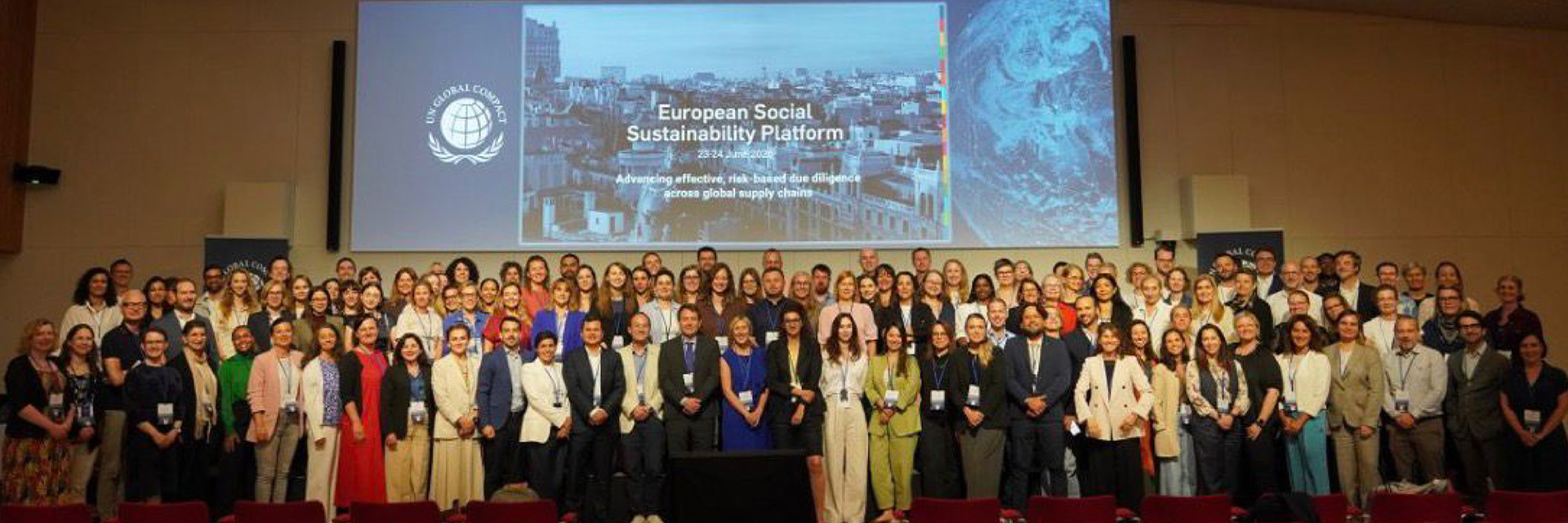
With this very question in mind, I had the opportunity to represent Borusan Group at the European Social Sustainability Platform meeting held at UN City in Copenhagen. The programme focused on human rights due diligence, social sustainability practices, and how the evolving regulatory landscape in Europe is being translated into corporate practice.
Beyond all these technical discussions, however, I returned from Copenhagen with a slightly different perspective.
My notebook is filled with regulatory developments, practical examples, and new concepts. But alongside all of that, I believe there is a much bigger question we should be asking ourselves:
How can social sustainability truly be put into practice?
Over the past few years, topics such as human rights, supply chain responsibility, grievance and remedy mechanisms, and just transition have become much more prominent in the business world. European legislation is accelerating this shift, while development finance institutions, major investors, and customers are setting similar expectations.
Today, companies have a much clearer understanding of what they need to disclose, which processes they should establish, and which risks they should assess. All of these developments are important.
But let’s be honest.
The challenge is no longer limited to publishing a policy, sending a supplier code of conduct, or conducting a few audits. These activities are already becoming standard practice. Policies are written, codes of ethics are shared, and training sessions are delivered.
But what happens next?
Are our day-to-day business practices really changing?
Even if we have managed to put our own operations in order, how do we influence the way our suppliers, customers, and business partners conduct their business?
The discussions in Copenhagen encouraged me to reflect on these questions once again.
Four themes, in particular, stood out throughout the meeting: whether rights holders are genuinely being heard; the contradictions within supply chains; whether grievance and remedy mechanisms remain only on paper; and how emerging risks are reshaping this entire picture.
1. We say we put rights holders at the centre. But are we really listening to them?
One of the most striking sessions during the meeting was a workshop built around heat stress and extreme temperatures.
We were presented with a realistic case study involving a construction company operating in Europe. Climate change-induced heatwaves, extreme heat stress, and increased exposure to ultraviolet radiation were creating serious health risks for workers on construction sites. As temperatures rose throughout the day, exposure increased, along with the associated health risks—from severe sunburn and vision loss to skin cancer and even heat-related heart attacks.
Our task was to develop solutions.
Everyone around the table assumed a different role: a finance professional, a human resources specialist, an occupational health and safety expert, a trade union representative, and an employee.
For me, the most interesting part of the workshop was not the list of solutions we developed, but the way the discussion unfolded.
Everyone spoke from the perspective of their assigned role. The finance professional focused on costs. The occupational health and safety expert explained the risks. Human resources discussed implementation. The union representative highlighted the importance of worker representation.
The employee remained silent.
According to the role description, the employee was not allowed to speak unless invited to do so.
After a while, that silence became the most powerful thing in the room.
We were sitting around a table trying to find solutions for employees, yet the employee was physically present without having a voice.
I believe this is a moment where we should pause and perhaps engage in a bit of self-reflection.
In our work on human rights and social sustainability, we sometimes stumble at exactly this point. We believe we are placing rights holders at the centre, yet too often we speak on their behalf, define their risks for them, and design solutions without truly hearing their perspectives.
However, particularly when it comes to issues such as heat stress—where climate change is directly transforming working conditions—it is difficult to develop effective solutions without first listening to the experiences of the people affected.
That is why establishing genuine and transparent dialogue with rights holders is such a fundamental part of human rights due diligence.
2. We expect suppliers to meet certain standards. But are we building relationships that enable them to do so?
Another topic that stayed with me was the contradictions involved in putting human rights commitments into practice throughout the supply chain.
On paper, the system appears well structured. Human rights expectations are communicated to suppliers, audits are conducted, checklists are completed, and corrective action plans are requested.
Yet when you look at day-to-day business practices, the picture can be quite different.
Long payment terms, increasing price pressure, rising quality expectations, and ever tighter delivery deadlines can all make it difficult for suppliers to maintain the very standards we expect them to meet.
This inevitably raises an important question:
Who is actually creating these risks?
Too often, we focus solely on the supplier’s shortcomings. Yet in some cases, the source of the risk is not the supplier’s lack of capacity, but our own procurement practices, payment terms, and commercial pressures.
A delayed payment or an unrealistic budget can directly affect a supplier’s ability to provide decent working conditions for its own employees.
Perhaps, then, the question should not always be:
“Why isn’t the supplier improving?”
Sometimes we need to ask ourselves instead:
“Are we building the kind of commercial relationship that enables suppliers to meet the standards we expect?”
For me, this was one of the most valuable insights from the meeting.
Because at this point, the conversation shifts away from expectations placed on others and turns back to the company’s own behaviour.
Conducting audits is relatively straightforward.
Questioning whether our own procurement model contributes to human rights risks is much more difficult.
I believe this is particularly relevant for companies operating in Türkiye.
In industries characterised by intensive manufacturing, logistics operations, and complex multi-tier supply chains, there is a significant difference between expecting SMEs to comply with high standards and creating the commercial conditions that actually allow them to do so.
3. Having a grievance mechanism is one thing. Building a mechanism that people trust is another.
Another topic discussed at length during the meeting was grievance and remedy mechanisms.
The key takeaway for me was the difference between having a mechanism and having one that actually works.
Many organisations today have ethics hotlines, whistleblowing channels, or reporting mechanisms in place. However, a large proportion of these systems were originally designed to deal with fraud, misconduct, conflicts of interest, or compliance violations.
Using the same channels for human rights issues—such as discrimination, harassment, wages, working hours, workplace relations, or social impacts arising in the supply chain—may initially seem practical.
But once you begin looking more closely, it becomes clear that this requires a significant shift in organisational behaviour.
One of the key messages shared during the meeting was that, from the perspective of rights holders, having one accessible and easy-to-use reporting mechanism is often the most meaningful approach.
This makes sense.
Rights holders need to know where they can raise concerns, understand how the process works, and, most importantly, feel safe throughout it.
From a company’s perspective, however, this is precisely where the challenge begins.
Expanding the scope of an ethics hotline means aligning legal, compliance, human resources, internal audit, occupational health and safety, and sustainability teams around a single mechanism.
Questions immediately arise.
Which reports should be handled by which function?
Who is responsible for reviewing each case?
How will confidentiality be protected?
How will remedy be provided?
How will recurring issues be monitored and addressed?
These are not minor design questions.
There is a considerable difference between establishing a reporting mechanism and ensuring that it actually functions effectively.
Another question also stayed with me:
Do we ever ask the people who use these mechanisms whether they actually work?
Can they access them easily?
Do they feel comfortable speaking up?
Do they trust the process?
Although grievance mechanisms exist in the vast majority of companies, only 16% measure their effectiveness by asking employees about their experience.
I found that statistic particularly striking.
Because in the end, the effectiveness of a grievance mechanism is determined not by whether it exists, but by whether people trust it enough to use it.
4. It Is Not Enough to Say “New Risks Are Emerging”—We Need to Integrate Them into Social Sustainability.
A significant part of the discussions in Copenhagen focused on emerging risks.
In particular, the research findings presented on the impact of artificial intelligence on women, its potential to reinforce discrimination in recruitment and performance management systems, its disproportionate impact on certain groups of workers, and its potential to lead to job displacement were particularly thought-provoking.
Artificial intelligence is often discussed in terms of productivity and efficiency.
But when we look at its social dimension, a different set of questions emerges.
Who is being left behind in this transformation?
Which jobs are becoming obsolete more quickly?
Who will need to reskill?
Who may be disadvantaged by algorithmic decision-making?
These are no longer simply questions about technology.
They are increasingly becoming questions about social sustainability and human rights.
Another topic that left a strong impression on me was conflict and fragility.
Geopolitical tensions, armed conflicts, migration, and operations in high-risk regions are making discussions on human rights far more complex.
One concept that particularly stayed with me was responsible exit.
Ending a business relationship, withdrawing from a market, or terminating a supplier contract may, at first glance, appear to be a straightforward crisis management decision.
From a human rights perspective, however, the situation is far less straightforward.
A sudden exit may create new hardships for workers, local communities, or stakeholders who are already in vulnerable situations.
At the same time, remaining may create different kinds of risks.
The issue, therefore, is not simply whether a company should stay or leave.
The more important questions are:
Who will be affected by this decision?
What impacts will it have on different stakeholders?
Under what conditions and through which approach should this transition be managed?
What kind of transition or management plan should accompany such a decision?
What Did I Bring Back from Copenhagen?
As I travelled home, one thing became even clearer to me.
Social sustainability is still regarded in many places as an issue of good intentions.
In reality, however, it is directly connected to business models, procurement practices, operational management, governance structures, and the decisions companies make during times of uncertainty.
Human rights cannot simply be delegated to suppliers.
Companies also need to examine their own commercial practices.
They need to genuinely listen to rights holders, establish grievance and remedy mechanisms that people trust, and recognise climate change, artificial intelligence, and conflict-related risks as interconnected parts of the broader social sustainability agenda.
I returned from Copenhagen with valuable insights and renewed motivation on all of these issues.
This is precisely the perspective we are bringing to our Human Rights Due Diligence work at Borusan.
Identifying risks is not enough.
We also need to recognise our own blind spots, engage more closely with our value chain, genuinely listen to rights holders, and connect our actions to everyday business processes.
If you asked me to sum up my biggest takeaway from Copenhagen in a single sentence, it would be this:
The real test of social sustainability begins when it reaches the ground—and we are committed to meeting that challenge.